
From rare disease identification to treatment adoption and disparities in care, our ISPOR research highlights how de-identified patient-level data and HEOR-focused analytics can support more timely, rigorous evidence generation.
At ISPOR, the value of real-world evidence lies in its ability to make complex healthcare questions more measurable, more transparent, and more actionable for decision-makers across Life Sciences, payer, and policy settings. Komodo Health’s contributions this year reflect that focus: using de-identified, research-grade patient journey data and analytics tools built for HEOR to examine treatment uptake, coding and identification challenges, disparities in care, and the economic burden of disease.
Together, our research shows how data and purpose-built analytics can help researchers move from observation to evidence on questions that matter for access, equity, utilization, and outcomes. Here are some highlights:
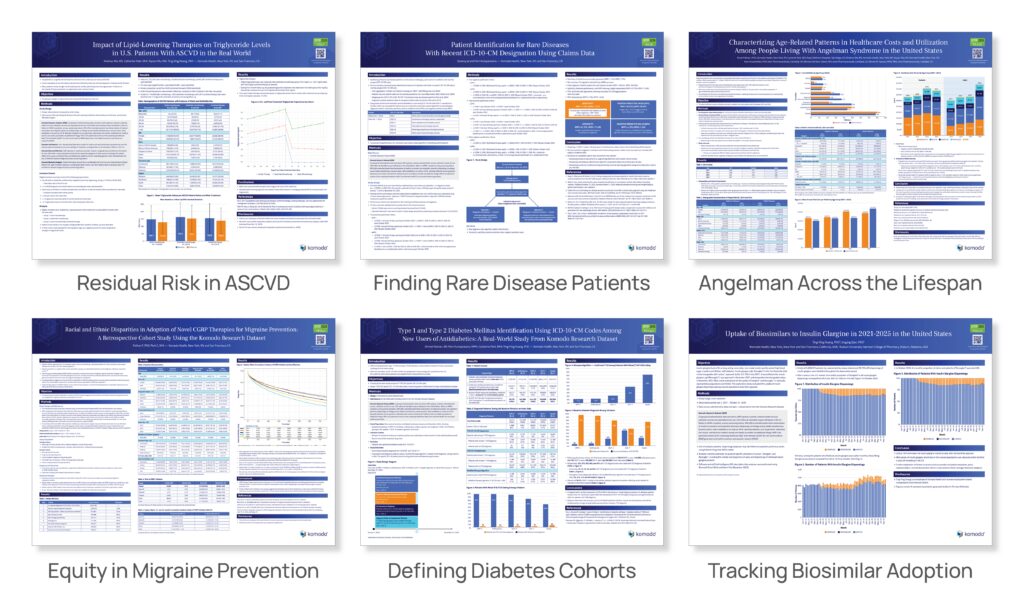
- Residual Risk in ASCVD: Among patients with ASCVD, this study examines lipid-lowering therapy use in relation to triglyceride levels in a real-world setting, offering a closer look at treatment patterns and persistent residual risk in a high-priority cardiovascular population.
- Finding Rare Disease Patients: Accurate patient identification remains one of the biggest barriers in rare disease research, especially when new ICD-10-CM codes have only recently become available. By focusing on claims-based identification in that setting, this research highlights how coding advances can expand opportunities for epidemiology, burden-of-illness, and outcomes research when paired with rigorous methodology.
- Angelman Across the Lifespan: Healthcare utilization and costs among people living with Angelman syndrome are examined across age groups in the United States, helping build a clearer picture of how burden changes across the lifespan. That kind of longitudinal perspective is especially valuable for health economic modeling, care planning, and policy discussions in rare disease.
- Equity in Migraine Prevention: Racial and ethnic differences in adoption of novel CGRP therapies for migraine prevention were assessed in a retrospective cohort study using the Komodo Research Dataset, with a focus on whether therapeutic innovation is reaching patients equitably in practice. For the ISPOR audience, that makes the research particularly relevant to ongoing conversations around access, equity, and variation in real-world care.
- Defining Diabetes Cohorts: Distinguishing type 1 from type 2 diabetes among new users of antidiabetic therapies is a foundational methodological issue, and this research examines how ICD-10-CM codes perform in making that distinction. The study underscores how credible HEOR and RWE depend on precise cohort definition and strong research design from the start.
- Tracking Biosimilar Adoption: Adoption patterns for insulin glargine biosimilars in the United States from 2021 to 2025 offer a real-world view into how uptake is unfolding in a clinically and economically important market. That makes the research highly relevant for stakeholders tracking market change, access dynamics, and the pace of lower-cost therapeutic transition.
In total, 34 research posters presented at ISPOR 2026 were powered by Komodo Health data.
Taken together, these studies reflect the breadth of questions that Komodo’s real-world evidence can help answer, from methodological rigor in patient identification to equity in treatment access, burden across the lifespan, and uptake of emerging or lower-cost therapies.
To see more articles like this, follow Komodo Health on LinkedIn, YouTube, or X, and visit our Resources Hub.
Talk to an expert about your next HEOR study.