
There is no shortage of AI tools available to pharma analytics teams. What’s harder to come by are AI solutions that work at the scale and speed the business requires.
The gap is almost never the model. It’s what sits underneath it: the data that feeds it, the clinical context that gives it meaning, and the governance layer that makes outputs something a leader can act on.
Most organizations are building those things right now. Some will get there. All of them are paying a cost in time and strategic momentum while they do.
The clearest indicator of where an AI program actually stands is the question the team is asking about its outputs. Teams still building their foundations ask: “Is this right? Can we reproduce it? Will it hold up under scrutiny?” Teams operating on solid ground ask, “What do we do with this? What should we ask next?” That shift is what earns a commercial analytics team its credibility.
Komodo Health® customer Alnylam has moved beyond that stage. At a launch event unveiling the next level of Marmot™ capabilities, Alex Trouteaud, Senior Director of Advanced Analytics and Data Strategy, shared what becomes possible on the other side.
What It Looks Like to Move Past the Baseline
When Trouteaud describes what changed for his team, the details are specific. The question he’s asking is no longer where to find the analysis or who has capacity to run it. It’s what to do next.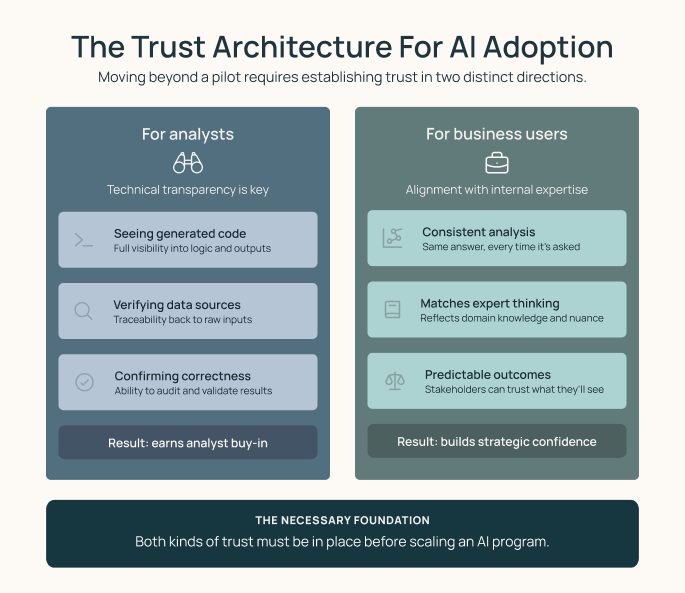
That shift started with trust, and he breaks it down into two directions. For analysts, trust means seeing the code Marmot generates, verifying it pulls from the right data sources, and confirming it runs correctly. Transparency at the technical level is what earns analyst buy-in. For business users, trust looks different: knowing that any analysis the platform runs is consistent with how their internal experts think about the problem. Both kinds of trust must be in place before an AI program can move beyond a pilot.
The moment that captures it most clearly: Alex was cooking dinner when a question occurred to him, the kind his team never had bandwidth to prioritize. He pulled out his phone, spent five minutes writing the question into Marmot, set it aside, and came back to a report that would have taken a team of analysts a week to produce. He asked follow-up questions. The answers went deeper. The whole thing happened outside of any prioritization process, any ticketing queue, any request to the analytics team.
What that looks like in practice is a question answered while dinner was cooking. A report that would have taken a week was delivered in the time it took to ask for it. A follow-up question that went deeper than the original analysis could. That is one analyst, one evening. Multiply it across a team operating every day on the same foundation, and the compounding effect is what separates an analytics organization from the competition.
That means the work compounds in ways it couldn’t before. Every definition, cohort, and methodology that the team validates gets stored and carried forward. A new analyst joins and picks up from where the team left off. A question that came up six months ago has a methodology already waiting. The specialist analytics team, freed from routine requests, moves on to the novel questions they never had the capacity to reach.
Three Things That Have to Be True
The results Alnylam is seeing today are a direct product of the foundation they built yesterday. High-performing healthcare AI requires three critical conditions to succeed. But while most organizations encounter these conditions as hurdles to clear, Alnylam treated them as the baseline.
The data has to be AI-ready. Clean, longitudinal, and built for the questions healthcare analytics actually asks. A model applied to unprepared data produces fast answers that cannot be trusted. Speed without a reliable foundation is not an advantage; it’s a liability that compounds every time someone acts on a result that was never sound to begin with. The Komodo Healthcare Map®, grounded in 330M+ de-identified patient journeys with 10 years of semantic context, ensures the right codes and data foundation are in place before the first question is asked.
The intelligence layer has to understand healthcare. Knowing that a prescriber behavior pattern signals an unmet need, or that an HCP affiliation reflects billing reality rather than a roster entry, requires clinical and commercial context built into the platform. A general-purpose model does not arrive with that context. Building it is a separate project.
Trust and governance have to be native, not added later. Traceability, reproducibility, and auditability are requirements. Retrofitting them after an AI program is underway is one of the more expensive lessons the industry is currently learning. When they are built into the platform from the start, they stop being a project and start being a given. Every number has a path back to the data. Users can generate the SQL behind any output and run it independently to verify. The system catches problems, not your team.
Alnylam did not build any of these. They were already in place.
What Becomes Possible on a Foundation That’s Already Right
Alnylam started with a working solution in Marmot, which meant they could look immediately to what comes next. Every analysis runs on 330M+ de-identified patient journeys with the clinical context to interpret them correctly. Every output traces back to the data behind it. Every methodology gets stored, reused, and carried forward across analysts and launches.
When leadership asks how they got to a number, the answer is already there. When a new analyst joins mid-launch, they pick up from the team’s existing work. The best thinking becomes institutional knowledge. That is what it means for work to compound, and for Alnylam, it’s the starting point.
Marmot is how they got there. The healthcare AI programs producing results share that common starting point: the data was right, the clinical context was built in, and governance was native to the platform. Organizations that made that choice early are operating at a different level now, and the gap is not closing quickly.
Alnylam’s results reflect a choice made before this conversation started. Every team has the same choice available. The question is what it costs to keep building the foundation yourself, and whether that is a problem worth inheriting.