
Agentic AI, built upon foundational large language models (LLMs), is demonstrating a remarkable capacity to transform industries. From analyzing real-world evidence and coding novel algorithms to orchestrating automated processes and reasoning through complex challenges, its potential seems boundless.
Yet, for the biopharmaceutical sector, a critical chasm separates this potential from practice. This gap is defined by two pillars of operation in a regulated environment: transparency and auditability. Without a clear line of sight into an AI’s decision-making process (transparency) and the verifiable proof of its conclusions (auditability), these powerful tools remain incompatible with GxP standards. This compliance gap doesn’t just slow innovation; it effectively bars Life Sciences from deploying AI where it’s needed most.
The Regulatory Gauntlet
The FDA’s position clarifies this divide. While internally focused AI for strategic planning or early-stage research and development may operate with relative freedom, the moment an AI output is externalized — informing a regulatory submission or shaping a label claim, for example — it enters a governed domain. In this context, the FDA mandates a comprehensive governance framework that demands end-to-end traceability, documented model validation, clear human oversight, and meticulous records of versioning to ensure a fully auditable trail from data to decision.
Here’s a synopsis of the FDA’s expectations across the drug life cycle:
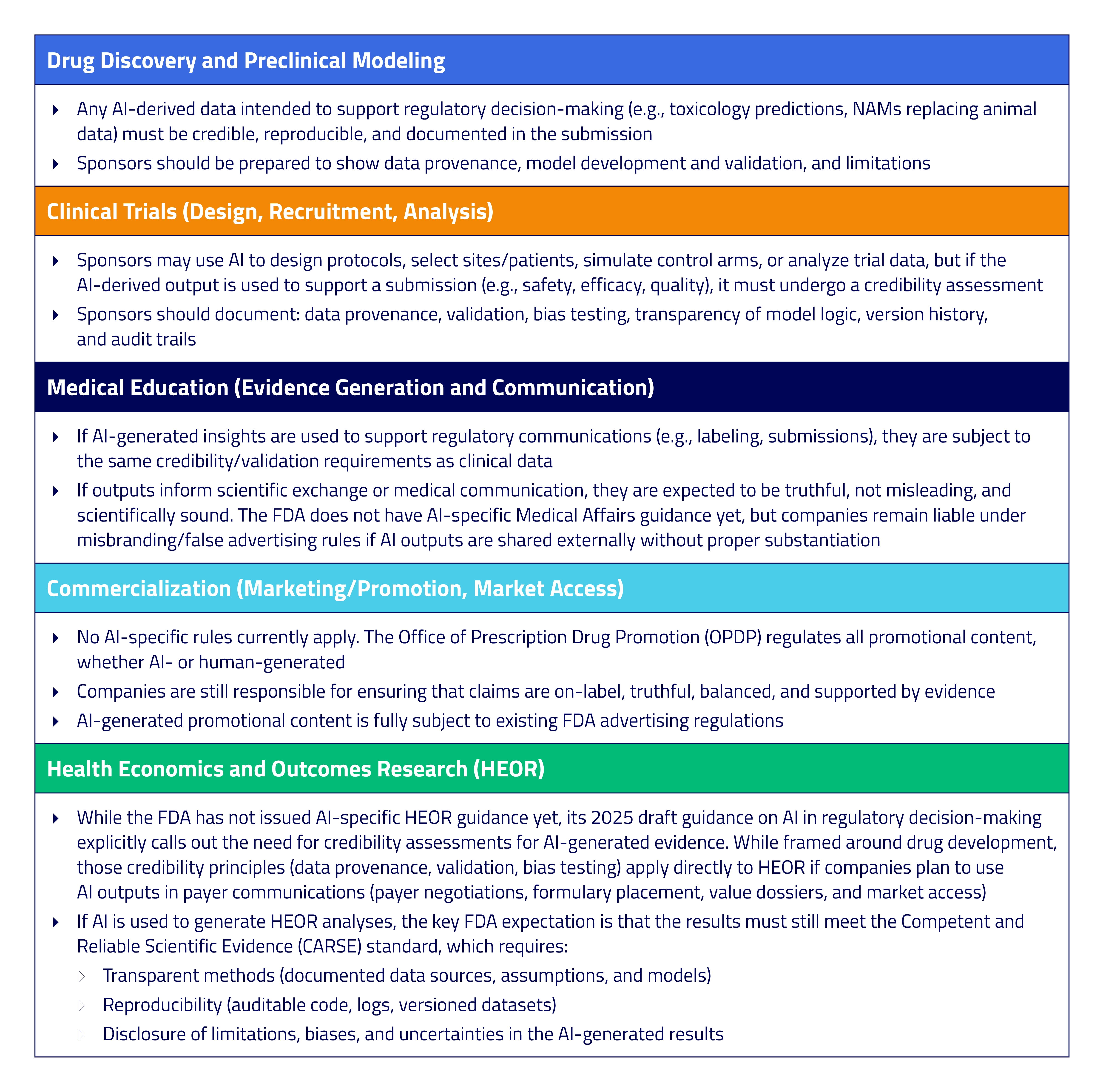
Building Trust
In order for biopharma companies to embrace agentic AI, they must first verify that these five critical components are inherent in its structure:
1. Explainable AI
There must be clear reasoning paths that domain experts can validate. These include exposing the methodologies and statistical confidence levels that support each conclusion.
2. Complete audit trails
Every decision, recommendation, and analysis must be accompanied by a comprehensive audit trail documenting the inputs, processing steps, and outputs. These trails should be immutable and accessible for both real-time monitoring and retrospective review.
3. Code transparency
The underlying code that powers analytical processes should be available for inspection so that technical stakeholders can validate that the implementation matches the documented methodology.
4. Validation checkpoints
AI systems should incorporate validation steps that compare their outputs against established benchmarks, flagging potential anomalies for human review.
5. Data provenance
Clear documentation of data sources, including their quality, completeness, and potential biases, is essential for contextualizing AI-generated insights.
When results are traceable and verifiable, agentic AI is transformed into a trusted co-pilot that enables biopharma to leverage LLM-level intelligence while simultaneously protecting patient outcomes and upholding regulatory integrity.
To ensure a thorough evaluation of agentic AI systems, download our checklist.
Komodo’s AI engine, Marmot™, is custom-built for the Life Sciences and healthcare industries and delivers the transparency and auditability that regulatory agencies require. Schedule a personal demo to see how it works.
To see more articles like this, follow Komodo Health on LinkedIn, YouTube, or X, and visit our Resources Hub.