
Explore the critical role of AI in the complex stage of early pharma commercialization.
The pharmaceutical industry is poised for a significant transformation, with investment in AI expected to grow over 40% annually — from $4 billion in 2025 to $26 billion by 2030. But what does this mean for the high-stakes, complex world of early-stage commercialization?
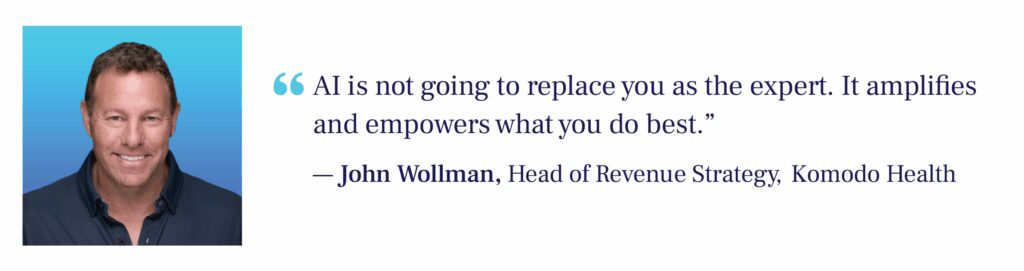
In a recent webinar, John Wollman, Head of Revenue Strategy at Komodo Health, drew on his 38 years of experience in data and technology to explore where AI should and should not be used in bringing a new drug to market. His core message was clear: AI is not here to replace the expert; it’s here to amplify and empower what you do best.
The Challenge: A High-Stakes Journey
Bringing a product to market is a monumental undertaking. The journey can span more than a decade and cost billions. Even after that investment, the odds are daunting.
- You have limited real-world outcomes data to share with payers
- Regulatory barriers are complex and inconsistent across different bodies
- 40% of new drug launches fail to meet their two-year sales forecasts
- 100% of launches experience some form of delay
It’s within this challenging environment that AI offers a powerful set of tools to augment human strategy.
Where AI Adds Value Today
Wollman identified five key areas where healthcare-native AI is already making a significant impact on early-stage commercialization strategy:
- Market research. AI can rapidly synthesize vast amounts of data to provide a deeper understanding of the market landscape. This includes mapping patient journeys, scanning for clinical trials and policy changes, and ensuring compliant development of materials for healthcare providers and regulatory bodies.
- Deeper engagement. AI excels at identifying and profiling key opinion leaders (KOLs) and healthcare professionals (HCPs). It can conduct rapid secondary market research using diverse datasets such as claims, EMR, and genomics to personalize content for individual KOLs — and even simulate message effectiveness before launch.
- Market access optimization. AI models can help predict payer behavior, formulary decisions, and health technology assessment outcomes. This predictive power allows teams to create and optimize value stories and health economics studies that resonate with payers.
- Brand strategy development. From synthesizing data for patient insights to supporting the creation of MLR-ready marketing content, AI streamlines brand strategy. It can drive marketing automation by improving audience identification and activation while simultaneously flagging compliance risks to streamline the MLR review process.
- Funding maximization. For startups and emerging companies, AI can accelerate the path to funding. It helps by matching startups with the right investors, speeding up the due diligence process by summarizing complex information, and supporting the creation of financial forecasts and pitch decks.
The Human Element: Where AI Falls Short
While AI is a powerful accelerator, it is not a silver bullet. Wollman emphasized that human oversight and judgment remain essential, especially in areas requiring deep nuance. AI currently falls short in:
- Regulatory nuance. It cannot replace the expertise of seasoned regulatory practitioners
- Complex negotiations. AI lacks the empathy and subtle judgment required for high-stakes payer or provider negotiations
- Creative brand storytelling. While it can generate copy, AI struggles to craft the authentic “why” behind a brand
- Emerging markets. AI is less effective at detecting implicit adoption signals in markets that lack a large evidence base for analysis
The Path Forward: AI + Human
The ultimate takeaway is that success is not a matter of “AI vs. human” but “AI + human.” To succeed, organizations need to invest in a high-quality data fabric and AI framework, establish clear governance for ethical deployment, and build cross-functional alignment on when to use — or not use — these powerful new tools.
By planning early and empowering teams to use AI responsibly, Life Sciences organizations can accelerate strategy, challenge assumptions, and, ultimately, improve patient impact.
To see more articles like this, follow Komodo Health on LinkedIn, YouTube, or X, and visit our Resources Hub.