
The Confidence Trap
Blind confidence in AI is an easy trap to fall into. A clean, fluent output can sound accurate, yet be completely wrong. This carries real consequences in healthcare, underscoring verifiable AI’s importance.
The stakes are high. A cohort definition off by one criterion changes trial eligibility. A drug interaction miscalculated at scale affects patients. An insight built on bad logic reaches decision-makers as fact, with no traceable source.
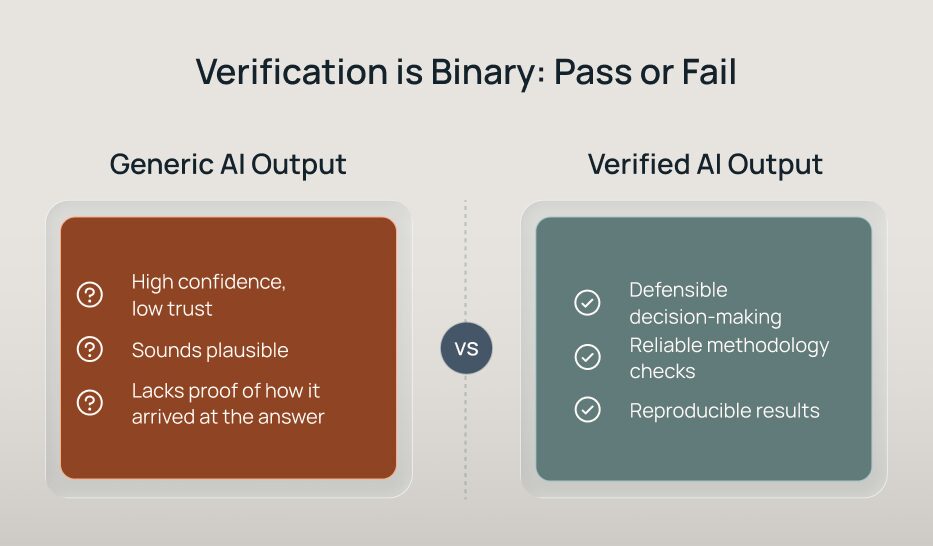
Confidence and trust are fundamentally different. The former is what a polished output earns instantly. Clinical trust requires proof: understanding how the system works, what data is checked, and exactly why an answer is correct. This is what Verifiable means in Komodo Health®’s Five Pillars of Trust framework.
It’s also why we embedded one question into every layer of Marmot™: “How do we prove this is right?”
What Verifiable AI Actually Requires
The term “Verified” means nothing on its own. Verified by whom and against what? At Komodo, verification means outputs are systemically checked before anyone sees them. We accomplished this through four critical components:
Clinicians tested the system before it touched clinical data. We conducted months of stress-testing sessions called “Prompt-a-Paloozas”, where clinicians asked questions the way they actually ask them at work, found inconsistencies we’d missed, and identified edge cases we had not thought of. What emerged was a foundation of evidence that clinicians themselves helped verify.
Checking happens during the run. Verification doesn’t stop at development. Every output cross-references against codesets, validates against clinical standards, tests methodology against accepted practices, and benchmarks against third-party sources. Lastly, critique agents review the work before it reaches you.
Healthcare-specific failures are solved at the architectural level, not patched afterward. Drug names change, coding standards shift, and current dates matter for age calculations, half-lives, and guideline adherence–problems where general-purpose models fail with complete confidence. We built domain logic directly into the system from the start.
Exportable code transforms verification from “trust-the-tool” to “run-and-check”. Once you can inspect the underlying logic, you’re no longer dependent on platform versioning or model updates. The analysis outlives the session, meaning a number from last March can be reproduced a year later by anyone with the files and data.
Questions to Ask a Healthcare AI Vendor About Verification
When evaluating healthcare AI, buyers should press hardest here. These are important questions to ask of any vendor:
- How is accuracy proven, and who validated it?
- What happens on an edge case outside the training data?
- How often are outputs checked before a user sees them?
- Have clinicians examined the system directly, and what did they change as a result?
- Can I export the code behind an answer, and will it run without your platform?
The last one sorts vendors quickly, because a system that can only answer inside its own runtime is asking you to trust it.
What We Have Not Solved
Verification catches what it is designed to. New failure modes require new verification checks; we discover and fix those by hitting them in the field.
Reproducibility has a floor set by the underlying data. When an upstream source changes, a rerun legitimately returns a different number. Our job is to surface that change clearly when it happens.
Exportable code places the responsibility for reading and review on your team. You gain transparency and the ability to conduct analysis on your own schedule, in exchange for engaging with the underlying logic. We think that’s a fair trade.
The Proof Is in the Details
We had clinicians test it, built the checking into the run, solved the healthcare-specific problems that general-purpose systems get wrong, and made the output executable on your terms. That’s not a claim, that’s design.
Verifiable is one of the five pillars that work together. Explainable shows you why an answer exists. Grounded and Governed keep it consistent across teams and settings. Reproducible keeps it stable over time. None substitutes for the others.
Healthcare AI deserves the same scrutiny clinicians apply to every other high-stakes decision. The way to meet that standard is simple: make it show its work.
About the Author
Kaushal Parikh is Head of AI Platform and Services at Komodo Health, where he has worked since 2016. He has spent time across the Komodo organization, including commercial, data partnerships, and data product. Today, he leads the platform behind Komodo’s AI products, enabling insights to be democratized and every answer to be trustworthy and verifiable. Connect with Kaushal
Frequently Asked Questions
What Is Verifiable AI in Healthcare?
Verifiable AI in healthcare is an AI solution that can prove its answers are correct. Its outputs are checked against codesets, clinical standards, and third-party benchmarks before a user sees them, and the logic behind each answer is open for review.
How Is Verifiable AI Different From Explainable AI?
Explainable AI shows why an answer exists, and verifiable AI proves the answer is correct. In Komodo Health’s Five Pillars of Trust framework, both work alongside Grounded, Governed, and Reproducible, and none substitutes for the others.
How Can You Check a Healthcare AI Output Yourself?
Export the code behind the answer and run it against the same data. Exportable code lets anyone with the files and data reproduce a result a year later, outside the vendor’s platform. If an upstream data source has changed, the rerun can return a different number, and that change should be surfaced clearly.